Played music science video on glycolysis and Kreb cycle.
Emphasized electron transport chain, went through the calculation of 38 ATP.
Emphasized negative feedbacks.
Summarized key learning objectives at the end.
Thursday, February 6, 2014

Wednesday, February 5, 2014
BIO233, Gram stain lab, Feb 5, 2014
Lab started around 2:05pm.
Two students explained procedures on board. I did demo on preparing smear and gram stain.
Problems and issues that need to be addressed in the future:
Some slides are oily, and cells could not be spread on them.
Some students are not sure how much water they would put on slides, or how to spread the water thinly.
Some students will do Gram stain in their own space instead of the sink.
Some over-decolorized the stain with 95% EtOH.
Some did not sufficiently decolorize the stain or add too much stain. Some crytal violet and safranin contain too much debris. New bottles of reagent should be bought when funds are available.
Several students did know how to use microscope properly.
Most students finished the lab within 40 minutes. Three students worked on their own and spent about 20 more minutes. Overall, the lab finished at 4:30pm.


Students could use their iPhones and took picture from the eye-pieces.
 |
| Gram-positive Bacillus megaterium |

Tuesday, February 4, 2014
metabolic problem sets
Good biochem problem sets
http://www.uvm.edu/~mcase/courses/chem205/answers_set3.pdf
http://www.uvm.edu/~mcase/courses/chem205/problem_set3.pdf
Some calculation and analysis questions
http://www.ncbi.nlm.nih.gov/books/NBK22432/
mutant enzyme is half effective to covert energy during the succinate to fumarate.
http://en.wikipedia.org/wiki/Succinate_dehydrogenase
Simple recall questions
http://www.faculty.une.edu/com/courses/bionut/distbio/obj-512/Chap22-practice%20questions.htm
ATPase, 10 protons -> 3 ATPs

http://www.ncbi.nlm.nih.gov/pubmed?cmd=Search&term=tuininga%20JE%20[au]%20AND%201999%20[dp]%20AND%20Pyrococcus%20furiosus&qd_page_no=0&sourceid=Mozilla-search
bio125, Feb 4, 2014, miniprep
I spent one hour going over the miniprep protocol. Questions asked by the students include: What does 'resuspend' mean? What is an eppendorf tube? Should samples be done sequentially or in parallel?
Students spent 1.5 hours on doing minipreps. Many students spent too much time at the 'lysis' step which led to poor yields, commented by S. Kioko. I should address this problem next time.
One group turned in their ApE assignment. The two students, both fairly intelligent, are not clear how to calculate protein length from nucleotide coding sequences.


bio233, Feb 4, 2014, morphology and structure
I went over MCAT requirement on microbiology, cell biology, biochemistry, and genetics.
I let students to create spiral shaped bacteria, spherical and rod shapes.
I went through chapter 3 slides, with clicker questions on how to interpret 'rates' from the concentration ~ time plots.
I let students to create spiral shaped bacteria, spherical and rod shapes.
I went through chapter 3 slides, with clicker questions on how to interpret 'rates' from the concentration ~ time plots.


Moodle grade book, adjust item weight to calculate finale grade
1. Log into your Moodle course page. On the left, click a "Grades" icon.

2. In the "Grader report" window, click the "Categories and items" tab.

3. Click the 'full view'.

4. You can adjust the 'Multiplicator' to give weights to each item.

5. You can go back to the 'view' window to check the student grades, and make sure this what you want.

6. Before do this, I suggest you to blind the "course total" from students. Make sure the changes are saved.

Note: The weights are mostly going to change during the course. So, I would do this final grade calculation at least in late part of the semester.
Monday, February 3, 2014
surface to volume ratio exercise,
#surface to volume ratio
surface_to_volome = function(r) { 3/r }
r= seq(1 ,100,by=1/10)
ratio = surface_to_volome(r)
plot( ratio ~ r, lwd=3, type='l')
y2 = 3- r
plot( y2 ~ r, lwd=3, type='l', ylab='ratio')
y3 = 3.2 - r^2
plot( y3 ~ r, lwd=3, type='l', ylab='ratio')


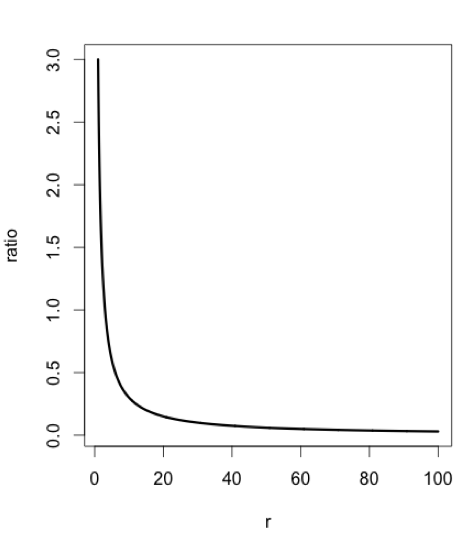
surface_to_volome = function(r) { 3/r }
r= seq(1 ,100,by=1/10)
ratio = surface_to_volome(r)
plot( ratio ~ r, lwd=3, type='l')
y2 = 3- r
plot( y2 ~ r, lwd=3, type='l', ylab='ratio')
y3 = 3.2 - r^2
plot( y3 ~ r, lwd=3, type='l', ylab='ratio')
Guesstimate rates from concentration ~ time plots
x = seq(0,2, by=1/100)
y1 = 0.7*x + 0.01
y2 = 0.2*x^2 + 0.01
y3 = 0.2*x^3 + 0.01
plot(y1 ~ x, type='l', ylab='relative concentration', xlab='time', lwd=2, ylim=c(0,1))
lines(y2 ~ x, col='red', lwd=2)
lines(y3 ~ x, col='blue',lwd=2)
dy1 = rep(0.7, length(x))
dy2 = 0.4*x
dy3 = 0.6*x^2
plot(dy1 ~ x, col='black', lwd=3, type='l', ylab='rate', xlab='time')
plot(dy2 ~ x, col='black', lwd=3, type='l', ylab='rate', xlab='time')
plot(dy3 ~ x, col='black', lwd=3, type='l', ylab='rate', xlab='time')

ApE, maverick, security and privacy
Maverick's defaulty security and privacy will not allow ApE to run. Change it to 'anywhere'.

After I have runned ApE, I changed it back to the default, and ApE still runs.
Saturday, February 1, 2014

FASTlane Spelman search
http://www.nsf.gov/awardsearch/advancedSearchNoScript?IncludeCoPI=false&BooleanElement=Any&BooleanRef=Any&HistoricalAwards=false&ActiveAwards=true&AdvSrchPage=True&PIOrganization=Spelman%20College
Subscribe to:
Posts (Atom)