This site is to serve as my note-book and to effectively communicate with my students and collaborators. Every now and then, a blog may be of interest to other researchers or teachers. Views in this blog are my own. All rights of research results and findings on this blog are reserved. See also http://youtube.com/c/hongqin @hongqin
Wednesday, July 31, 2013
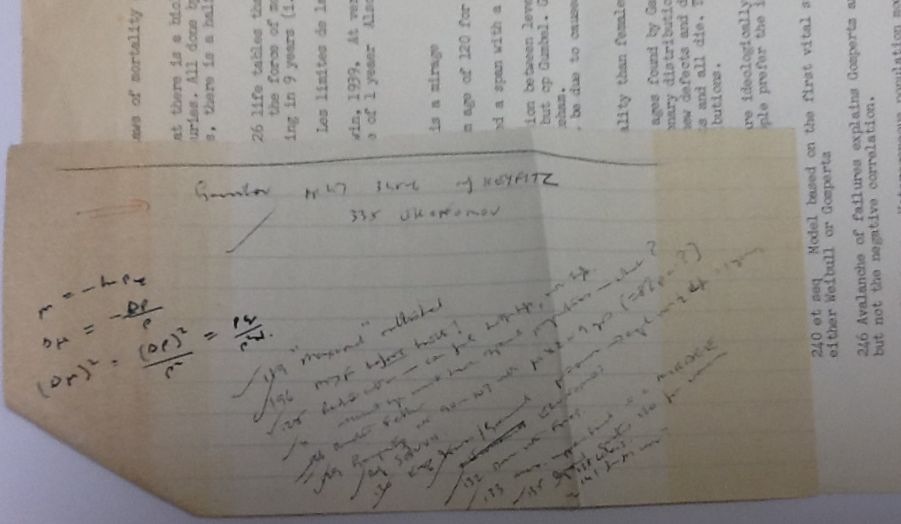
Whose notes are these?
I bought a used copy of The Biology of Life Span: A Quantitative Approach, by LA Gavrilov and NS Gavrilova. This used book contains two pages of notes. There are not many people working on the theoretic and quantitative aging modeling in the world. So, I wonder who do they belong to.
GG91, 6.2, the need for a critical attitude to mathematical models of lifespan
GG91 discussed several instances of 'blatant errors' in 6.2.
The first is EA Murphy 1978, "Genetics of longevity in man". Murphy78 proposed a $k$ subsystems in a serial configuration, and each subsystems break down after $n$ random damages. GG91 shows an error of differentiation in the published results.
The second example is Skurnick and Kemeny, 1978, Mechanisms of Ageing and Development. SK78 argued that 'an organism' as a 'chain' whose strength is determined by the 'weakest link'. GG91 connected SK78 with the 'Bingo model'. SK78 used the extreme value distributions. SK78 inferred the Weibull model of aging and Gompertz model in old ages. GG91 stated that SK78's approximation of Gompertz model is incorrect because maximum approximation rule was used for minimum approximation. GG91 argues that this is a case that intuition and common sense would prevent such errors from happening.
The third example is Koltover 1983, Progress in Modern Biology. Koltover83 argued that death of an organism is the result of damage to at least one of the $Q$ blocks of genes in the genome. GG91 described this assumption as 'stupidity', because GG91 argued that every cell has its own genome. This critique seems to be a misplaced because K83 model can be viewed as a 'genetic interaction model', which is commonly used in evolutionary genetics.
K83 used $m_c$ for a critical value of 'disfunction' and seems to be deterministic in nature and lead to simulanenous death of a homogeneous population. K83 then introduced heterogeneity using a truncated exponential distribution to describe different populations.
The fourth example is Witten 1985, Mechanisms of Ageing and Development. GG91 shows that the derived Gompertz coefficient in W85 cannot be positive if its assumption were also positive. In other words, W85 seemed to be working on a exponential growth model if the final Gompertz derivation holds.
The first is EA Murphy 1978, "Genetics of longevity in man". Murphy78 proposed a $k$ subsystems in a serial configuration, and each subsystems break down after $n$ random damages. GG91 shows an error of differentiation in the published results.
The second example is Skurnick and Kemeny, 1978, Mechanisms of Ageing and Development. SK78 argued that 'an organism' as a 'chain' whose strength is determined by the 'weakest link'. GG91 connected SK78 with the 'Bingo model'. SK78 used the extreme value distributions. SK78 inferred the Weibull model of aging and Gompertz model in old ages. GG91 stated that SK78's approximation of Gompertz model is incorrect because maximum approximation rule was used for minimum approximation. GG91 argues that this is a case that intuition and common sense would prevent such errors from happening.
The third example is Koltover 1983, Progress in Modern Biology. Koltover83 argued that death of an organism is the result of damage to at least one of the $Q$ blocks of genes in the genome. GG91 described this assumption as 'stupidity', because GG91 argued that every cell has its own genome. This critique seems to be a misplaced because K83 model can be viewed as a 'genetic interaction model', which is commonly used in evolutionary genetics.
K83 used $m_c$ for a critical value of 'disfunction' and seems to be deterministic in nature and lead to simulanenous death of a homogeneous population. K83 then introduced heterogeneity using a truncated exponential distribution to describe different populations.
The fourth example is Witten 1985, Mechanisms of Ageing and Development. GG91 shows that the derived Gompertz coefficient in W85 cannot be positive if its assumption were also positive. In other words, W85 seemed to be working on a exponential growth model if the final Gompertz derivation holds.
Tuesday, July 30, 2013
Witten 1985 MAD, critical elements in a graph and Gompertz model
Witten 1985, Mech Ageing and Dev. 1985.
Witten85 used $R(t)$ as the survival function. $h_0$ as the initial mortality rate, $\gamma$ as the Gompertz coefficient. Witten85 seems to treat probability = reliability (page 142), which is different from Leemis's approach.
Witten85 assumed $m$ critical components in a graph model of a cell. There existed a critical number $m_c$ that is the threshold for the system (cell) to fail. This is equivalent to the parallel block configuration used by GG01.
Witten85 used Markov transitional states to model the failure of each critical component $M*$. I did not see how these transitional states are used for his derivation of the Gompertz model.
Witten85 used 'deviation' concept from Witten83. Witten85 assumes exponential failure function for each critical component (page 148), similar to GG01. It seems that although 'deviation' argument was used, it was not incorporated into the building toward Gompertz model.
In Eq 21, Witten85 shows that system viability (reliability) $R_SYS$ is basically the viability function of a serial system. Witten85 assumed a 'critical time' $t*$ (page 148), and approximate the binomial form in Eq 21 to obtain the Gompertz form using the exactly approximation used by GG91.
It is perplexing to me that Eq21 shows a serial configuration (based on Eq 14), but Witten85 argues for parallel configuration in Eq 13. For serial system, the product form also means that any single failure of the critical components will lead to system failure. If 'all of the critical elements must fail' for a system to fail, it should be a parallel configuration.
Witten85 introduced 'cost' in Eq 30 on page 152: Cost ~ m^beta, where $m$ is the number of critical elements.
Witten85 used $R(t)$ as the survival function. $h_0$ as the initial mortality rate, $\gamma$ as the Gompertz coefficient. Witten85 seems to treat probability = reliability (page 142), which is different from Leemis's approach.
Witten85 assumed $m$ critical components in a graph model of a cell. There existed a critical number $m_c$ that is the threshold for the system (cell) to fail. This is equivalent to the parallel block configuration used by GG01.
Witten85 used Markov transitional states to model the failure of each critical component $M*$. I did not see how these transitional states are used for his derivation of the Gompertz model.
Witten85 used 'deviation' concept from Witten83. Witten85 assumes exponential failure function for each critical component (page 148), similar to GG01. It seems that although 'deviation' argument was used, it was not incorporated into the building toward Gompertz model.
In Eq 21, Witten85 shows that system viability (reliability) $R_SYS$ is basically the viability function of a serial system. Witten85 assumed a 'critical time' $t*$ (page 148), and approximate the binomial form in Eq 21 to obtain the Gompertz form using the exactly approximation used by GG91.
It is perplexing to me that Eq21 shows a serial configuration (based on Eq 14), but Witten85 argues for parallel configuration in Eq 13. For serial system, the product form also means that any single failure of the critical components will lead to system failure. If 'all of the critical elements must fail' for a system to fail, it should be a parallel configuration.
Witten85 introduced 'cost' in Eq 30 on page 152: Cost ~ m^beta, where $m$ is the number of critical elements.
Witten 1983, MAD,
Witten83MAD argues for a systems approach and argues that a 'local model' is need for mechanistic insights.
Its aging model in linear form is:
Its threshold-like aging model is:
Witten83 then use mortality rate and survival function to find a probability density function, called a "general form of mortality" (page 75). Witten83 parametrized $\alpha_R(t)$ for detailed studies.
Without loss of generality, let us consider a single cell as our system of interest. When a new cell comes into being, it must function in some "average normal" manner (we'll assume that we are examining normal cells). In order for a cell to function in this "average normal manner" it must have some idea of what functions it must perform. That is to say, if it is a pancreatic islet cell then it must do all those things a "normal" pancreatic islet cell must do. This knowledge must be abstractly embedded in the cell as programming an internal model/rules and laws - whatever you choose. In brief, the cell has a set of internal perceptions as to what its normal function in a normal environment must be. (page 71, Witten83MAD).
If, as clock time passes, the cell's external environment changes in some substantialWitten83 use $R_SYS$ as survival function, and $\lambda$ as mortality rate. Witten83 formulated the normal deviation $\alpha_N$ and aging devivation $\alpha_R(t)".
manner, then the deviation between the cell's programmed picture of the normal world environment and the real world environment becomes quite large. The consequence of this deviation could well be the development of reversible and non-reversible agerelated effects. In the following paragraphs, we investigate how these concepts may be formalized. This will lead us to a definition of senescence in terms of these deviations. (page 72).
Its aging model in linear form is:
Its threshold-like aging model is:
Witten83 then use mortality rate and survival function to find a probability density function, called a "general form of mortality" (page 75). Witten83 parametrized $\alpha_R(t)$ for detailed studies.
Talk with Lou, exit interview
Lou came to my office and talked with me for about 40 minutes. Lou mentioned that new MCAT will emphasize more on statistics.
Fastlane tips
https://www.fastlane.nsf.gov/NSFHelp/flashhelp/fastlane/FastLane_Help/prepare_a_new_notification_or_request_as_a_pi.htm
I followed the above instruction, filed an "NSF Approved No-Cost Extension", in order to use the residual fund to cover the registration cost for a September meeting.
Note: Change of closing date should be filed 45 days in advance.
Monday, July 29, 2013
PubMed to BibTex
1. BibDesk through HubMed
BibDesk seems to run on Mac, Windows, and Linux.
2. Texmed
http://www.bioinformatics.org/texmed/
Copy-past from TexMed to *.bib files include "quotes". So, I have manually add the fields in BibDesk.
BibDesk seems to run on Mac, Windows, and Linux.
2. Texmed
http://www.bioinformatics.org/texmed/
Copy-past from TexMed to *.bib files include "quotes". So, I have manually add the fields in BibDesk.
Comparison of mortality rates, human, medflies, fruit flies, worms, yeast and automobiles, Vaupel et al. 1998 Science
Vaupel et al. 1998 Science plotted the death rate (mortality rate) for human, medflies, wasps, fruit flies, worms, yeast, and automobiles in its Figure 3. The plot on human was zoomed in to between age 80 and 120, because the Vaupel98Sci seem to emphasize the late life differences.
A Scholar search shows many engineering hits on automobile and Weibull modeling.
Sunday, July 28, 2013
Feynman's comment on experimental skill and openning toothpaste tube.
This is a good example of edutainment. I should edit a video on this topic.
See:
http://blogs.scientificamerican.com/oscillator/2013/07/27/feynman-on-biology/
There was one useful lab technique I learned in that course which I still use today. They taught us how to hold a test tube and take its cap off with one hand (you use your middle and index fingers), while leaving the other hand free to do something else (like hold a pipette that you’re sucking cyanide up into). Now I can hold my toothbrush in one hand, and with the other hand, hold the tube of toothpaste, twist the cap off, and put it back on. (From Surely You're Joking, Mr. Feynman).
See:
http://blogs.scientificamerican.com/oscillator/2013/07/27/feynman-on-biology/
Friday, July 26, 2013
Baudisch 2011 Methods in Ecology and Evolution, The pace and shape of ageing
Baudisch 2011, The pace and shape of ageing.
Baudisch11 standardized survive curves by normalizing age by its own expectation: x / E[x] . This is a very good idea and can be used to compare survive curves in different species with different time scale. For my work, it makes comparing yeast replicative and chronological lifespan possible.
Baudisch11 argues that 'shape' is a unit-less measure, and 'pace' is basically 'rate' with unit 1/time.
Shape measures discussed are:
Omega/L (Omega is age at 1% viability, and L is the average age).
mu(Omega) / mu(0) or \bar{mu}
mu(L)/mu(0) or \bar{mu}
Pace measures argued by Baudisch11 seem to include the two canonical Gompertz parameters.
In its Figure 3, L, Omega, and Maturity seem to be considered as 'pace' measures, too.
Baudisch11 uses 'mortality' for 'mortality rate', which can be seen in her description of the Gompertz model.
Baudisch11 discussed a measure proposed by Ricklef1998 and argued that it is problematic.
It can be seen that x/E[x] is unitless. So, Baudisch11 approach is a nondimensionalization treatment.
Baudisch11 discussed some previous work on dimensionless analysis of aging: Pearl and Miner 1935, Eakin 1994.
Numerically, it is straightforward to calculate the 'shape' measures. However, it is not straightforward to find the analytic form of the shape measures based on the Gompertz or Weibull models.
The median lifespan, i.e., the 50% quantile, has a analytic solution. So, normalization by the median lifespan can be used for both theoretical and empirical analysis.
Baudisch11 standardized survive curves by normalizing age by its own expectation: x / E[x] . This is a very good idea and can be used to compare survive curves in different species with different time scale. For my work, it makes comparing yeast replicative and chronological lifespan possible.
Baudisch11 argues that 'shape' is a unit-less measure, and 'pace' is basically 'rate' with unit 1/time.
Shape measures discussed are:
Omega/L (Omega is age at 1% viability, and L is the average age).
mu(Omega) / mu(0) or \bar{mu}
mu(L)/mu(0) or \bar{mu}
Pace measures argued by Baudisch11 seem to include the two canonical Gompertz parameters.
In its Figure 3, L, Omega, and Maturity seem to be considered as 'pace' measures, too.
Baudisch11 uses 'mortality' for 'mortality rate', which can be seen in her description of the Gompertz model.
Baudisch11 discussed a measure proposed by Ricklef1998 and argued that it is problematic.
It can be seen that x/E[x] is unitless. So, Baudisch11 approach is a nondimensionalization treatment.
Baudisch11 discussed some previous work on dimensionless analysis of aging: Pearl and Miner 1935, Eakin 1994.
Numerically, it is straightforward to calculate the 'shape' measures. However, it is not straightforward to find the analytic form of the shape measures based on the Gompertz or Weibull models.
The median lifespan, i.e., the 50% quantile, has a analytic solution. So, normalization by the median lifespan can be used for both theoretical and empirical analysis.
Baudisch & Vaupel, 2012, Science, Getting to the root of aging.
"Getting to the root of aging", Annette Baudisch, James Vaupel, 2012 Science.
BV12 focused on the three patterns of aging in biology: 1) Increasing mortality rate over age in human, mammals and birds; 2) Flat mortality rate over age in freshwater polyp Hydra vulgaris; 3) Decreasing mortality rate over age in tortoise Gopherus agassizii and many reptiles, amphibians, fish, and plants.
BV12 discussed Baudisch12Gerontology, where Baudisch discussed various models. It was mentioned that enhanced repair and maintenance can lead to flat or decreasing mortality rate over age. Increasing reproductive potential with age was also mentioned.
Estep 2010 argues that decline asexual reproduction is an indicator of senescence in hydra.
I thought a plausible way to explain the decreasing mortality rate in tortise is to use the parasites or viruses argument: older individuals are more resistant to pathogens.
I had a discussion with Adam Reitzel, UNC Charlotte about hydra aging at SMBE2013. We discussed whether hydra has an more active repair/renewal mechanism than other organisms. This lead me to wonder about the aging pattern in planarian. I found one article, Mouton11, that reported lack of metabolic aging in Schmidtea polychora.
References:
Turner FB, Berry KH, Randall DC, White GC. Report No. 87-RD-81”. Southern California Edison Company; 1987. “Population ecology of the desert tortoise at Goffs, California, 1983-1986.
(I did not find online sources for this reference).
MartÃnez DE. Exp. Gerontol. 1998;33:217
BV12 focused on the three patterns of aging in biology: 1) Increasing mortality rate over age in human, mammals and birds; 2) Flat mortality rate over age in freshwater polyp Hydra vulgaris; 3) Decreasing mortality rate over age in tortoise Gopherus agassizii and many reptiles, amphibians, fish, and plants.
BV12 discussed Baudisch12Gerontology, where Baudisch discussed various models. It was mentioned that enhanced repair and maintenance can lead to flat or decreasing mortality rate over age. Increasing reproductive potential with age was also mentioned.
Estep 2010 argues that decline asexual reproduction is an indicator of senescence in hydra.
I thought a plausible way to explain the decreasing mortality rate in tortise is to use the parasites or viruses argument: older individuals are more resistant to pathogens.
I had a discussion with Adam Reitzel, UNC Charlotte about hydra aging at SMBE2013. We discussed whether hydra has an more active repair/renewal mechanism than other organisms. This lead me to wonder about the aging pattern in planarian. I found one article, Mouton11, that reported lack of metabolic aging in Schmidtea polychora.
References:
Turner FB, Berry KH, Randall DC, White GC. Report No. 87-RD-81”. Southern California Edison Company; 1987. “Population ecology of the desert tortoise at Goffs, California, 1983-1986.
(I did not find online sources for this reference).
MartÃnez DE. Exp. Gerontol. 1998;33:217
Estep, Exp Gerontol. 2010 Sep;45(9):645-6. doi: 10.1016/j.exger.2010.03.017. mm
Declining asexual reproduction is suggestive of senescence in hydra: comment on Martinez, D., "Mortality patterns suggest lack of senescence in hydra." Exp Gerontol 33, 217-25
Mouton S, Willems M, Houthoofd W, Bert W, Braeckman BP. Exp Gerontol. 2011 Sep;46(9):755-61. doi: 10.1016/j.exger.2011.04.003. Epub 2011 Apr 23. Lack of metabolic ageing in the long-lived flatworm Schmidtea polychroa.
Declining asexual reproduction is suggestive of senescence in hydra: comment on Martinez, D., "Mortality patterns suggest lack of senescence in hydra." Exp Gerontol 33, 217-25
Mouton S, Willems M, Houthoofd W, Bert W, Braeckman BP. Exp Gerontol. 2011 Sep;46(9):755-61. doi: 10.1016/j.exger.2011.04.003. Epub 2011 Apr 23. Lack of metabolic ageing in the long-lived flatworm Schmidtea polychroa.
Thursday, July 25, 2013
Six degree of separation based on random graph, Watts and Strogatz ln V/ lnK
Based on Wikipedia entry, Watts and Strogatz showed that average path length between two nodes in a random network is lnV/lnK, where V is the number of node, and K is the average degree.
So, ln 6.7 billion / ln (50 friends) = 5.7.
See also:
https://en.wikipedia.org/wiki/Six_degrees_of_separation#Research
So, ln 6.7 billion / ln (50 friends) = 5.7.
See also:
https://en.wikipedia.org/wiki/Six_degrees_of_separation#Research
Subscribe to:
Posts (Atom)