Monday, June 25, 2018

Couse merge request


UTC, UTCLearn Support

9:51 AM (1 hour ago)
to FACULTY@RAVEN.UTC.EDU Unsubscribe
Instructors:

Fall 2018 courses have been created, and are now available to you in UTC Learn.  Students will be added to courses one (1) week before the first day of classes (8/13/2018).  If you would like to merge any of your courses, please complete the course merge request form located at:


If you need additional assistance, please contact the Walker Center for Teaching & Learning (utclearn@utc.edu or 423-425-4188).

_________________________
UTC Learn Administrator
Walker Center for Teaching & Learning
utclearn@utc.edu

Fall 2018
CPSC2100 CRN 45179 software design and development

CPSC4999 CRN48778 computational genomics
CPSC4999 CRN 50405 computational genomics
BIOL4999  CRN48263 computational genomics
CPSC5910R CRN48779 computational genomics
For merge request:
 48778  ,  50405 ,  48263 ,  48779 

Sunday, June 24, 2018

nano sim card


Nano SIM is both smaller and approximately 15% thinner than the earlier Micro SIM(3FF) standard as well as the Mini SIM (2FF) cards that were ubiquitous for many years and people commonly refer to simply as SIM cards.Apr 9, 2018


Nano SIM is the fourth version, or the "fourth form factor" (4FF) of the SIM standard and measures a mere 12.3 mm by 8.8 mm by 0.67 mm, but still holds the same amount of data as earlier SIM cards.Apr 9, 2018


controllability and mirror effect of adjacency matrix


using the matrix eigen value genometric multiplicity, the adjacentcy matric matrix can be mirrored, and its control nodes should not be changed, based on my intuitive understanding.

insert figures into Rmd, example


---
title: "sandbox"
author:
date: "June, 2018"
output: html_document
---

```{r}
library("pracma")
library("Smisc")
```

#Run these matrices from Yuan2013
#ToDo in the next version
#next build a data structure to run more networks systematically.

#plug in these matrices into matrix A variable above
#then find n_D

![YuanFig1](figures/fig1.yuan.png)


```{r fig1A_a}
A_a<-matrix(c(0,1,1,1,1,1,1,1,0,0,0,0,1,0,1,0,0,0,1,0,0,0,0,0,1,0,0,0,0,1,1,0,0,0,1,0),nrow=6,ncol=6)

A_a;

eig<-eigen(A_a);
eig;

#functionND(A_a)


```


```{r fig1A_b}
A_b<-matrix(c(1,0,0,0,0,0,1,1,0,0,0,0,1,0,1,0,0,0,1,0,0,1,0,0,1,0,0,0,1,1,1,0,0,0,0,1),nrow=6,ncol=6)

A_c<-matrix(c(0,1,1,1,1,1,1,0,1,1,1,1,1,1,0,0,1,1,1,1,0,0,1,1,1,1,1,1,0,1,1,1,1,1,1,0),nrow=6,ncol=6)

```

#nd_names = c( 'network','network_size','eigen-values','eigen-vectors','nd')
#nd= data.frame(matrix(, nrow=3, ncol=length(nd_names)) #set up a skeleton table

#names(nd) = c( "network","network_size","eigen-values","eigen-vectors","nd")

```{r}

#result<-data.frame(network_name=c("A_a","A_b","A_c"),
#            network_size=c(length(A_a[1,]),length(A_b[1,]),length(A_c[1,])),
#            driver_nodes=c(functionND(A_a),functionND(A_b),functionND(A_c)));

#result;       
```

Thursday, June 21, 2018

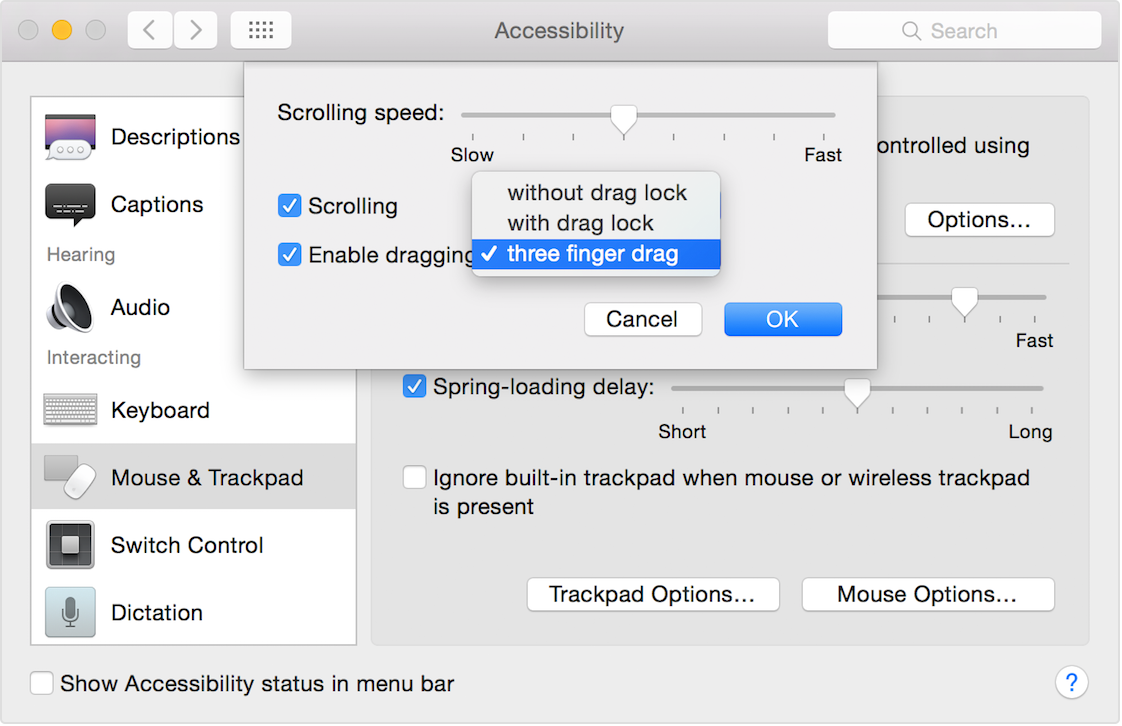
turn on three finger drag on apple laptop


https://support.apple.com/en-us/ht204609


Turn on "three finger drag" for your Force Touch trackpad

"Three finger drag" is a Multi-Touch gesture in OS X. It lets you use three fingers to move the active window on your screen.
Here's how to turn on three finger drag if your Mac has a Force Touch trackpad
  1. From the Apple menu, choose System Preferences.
  2. Click the Accessibility icon.
  3. Choose Mouse & Trackpad from the options on the left.
  4. Click Trackpad Options.
  5. Place a checkmark next to "Enable dragging." 
  6. From the related pop-up menu, choose “three finger drag” so there's a checkmark next to it.
  7. Click OK.
Published Date: 

Wednesday, June 20, 2018

folder with large file size on applejack

Folders with large file size


applejack:MobileSync hqin$ pwd
/Users/hqin/Library/Application Support/Google
Google File stream temporary uploading file

/Users/hqin/Library/Application Support/MobileSync
iPad syn storage.

Monday, June 18, 2018

CRISPR in budding yeast

Cut
Fully functional CRISPR/Cas enzymes will introduce a double-strand break (DSB) at a specific location based on a gRNA-defined target sequence. DSBs are preferentially repaired in the cell by non-homologous end joining (NHEJ), a mechanism which frequently causes insertions or deletions (indels) in the DNA. Indels often lead to frameshifts, creating loss of function alleles.
To introduce specific genomic changes, researchers use ssDNA or dsDNA repair templates with homology to the DNA flanking the DSB and a specific edit close to the gRNA PAM site. When a repair template is present, the cell may repair a DSB using homology-directed repair (HDR) instead of NHEJ. In most experimental systems, HDR occurs at a much lower efficiency than NHEJ.
https://www.addgene.org/crispr/yeast/

There different types of CRIPSR/Cas kits: cut, based editing, nick, activate, and interference.

https://benchling.com/pub/ellis-crispr-tools

edX video files

Video files can be downloaded from EdX YouTube videos